
L1-10 TIME MANAGEMENT AND HEALTHY STAFF RHYTHMS
INTRODUCTION
“Time management”, “Ordering our life in the world”, “structure”, “boundaries,” and, “schedules,” are all titles for living in tune with where God is leading us moment by moment. Order and structure, plans and schedules, help us live life in Christ with purpose, with priorities and with other people. “Structure” and “order” are not always words we use to describe what our schedules look like in ministry. Rhythms may be a better way to think about how we plan and manage our time and schedules.
If we read Jesus' teaching in John 15, we can see our work is designed to come from a place of rest. Our bearing of fruit, comes only with seasons of abiding. In this post you’ll take an honest look back at your time on staff over the last year, hopefully give thanks, and make course corrections for increased health moving forward.
Evidence of staff demonstrating this objective looks like:
- Demonstrates a good rhythm of ministry and rest
- Understand their natural tendency for time and decision making.
- Maintain a calendar and practice planning and time management that works for well for who you are.
- Values sabbath and keeps regular sabbath rhythms.
- Understands the expectations of their supervisor and strives to fulfill them in a timely manner.
There are two major types of people serving on Young Life staff. First, those who thrive in a schedule that comes without a set structure. The others are those who prefer a consistent, set and directed structure for their schedule. The first group loves each day, week or season that asks them to work different hours for different seasons of the year. The latter group seeks something more consistently Monday-Friday and 8am-5pm.
For the latter folks, it must be that your calling from Christ is stronger than your personal preferences because Young Life staff is rarely a M-F, 8-5 job for those in the field. Relationships are hard to schedule and travel happens often. For the first group of people - those of you who love the creative privilege that comes with the lack of a schedule, you might relish your freedom but you will not last long if you don’t employ some sort of consistency and purpose.
Since it’s been almost a year, how are you feeling about the rhythms of the job? Are you exhausted or energized? What sort of a handle do you have on your time and to-do list? Write your thoughts down and bring them to your next training meeting.
Another factor is our own personalities and how God has designed each of us individually. Some of us naturally organize and order our schedules so that we can function best. Others of us naturally seek options and opportunities, and scheduling too far in advance can feel limiting and restrictive. There is purpose and need for both types of personalities. We need to be aware of who we are and how our personality can benefit us in our leadership and how it can challenge us. Take the 16 Personalities online inventory here and be prepared to discuss this with your trainer at your next meeting:
Wisdom on how to spend our days can be found in the quotes of writers and leaders, as well as, most importantly, the Bible. Consider these wise words on how to spend time.
“God didn’t call us to be successful; He called us to be faithful.”- Mother Teresa
“It’s not enough to be busy. The question is, what are we busy about?”- Henry David Thoreau
“The things that matter most must never be at the mercy of the things that matter least”- Johann Wolfgang von Goethe.
Read these scriptures with eyes and ears towards time and God’s presence inside our ordinary days.
- God creates time (the original rhythm-day/night) - Genesis 1:1-5
- God keeps time - Psalm 74:16
- God gives rest and production when God leads - Psalm 127:1-2
- God’s pays attention to each day - Lamentations 3:22-24
- God (who is outside of time) entered into time - Luke 2:1-7
- Jesus directs attention enough for each day - Matthew 6:33-34
- God is the one who brings wisdom to our days - 1 Corinthians 2:6-7
- Christ fulfills time - holds all things together in time - Colossians 1:15-20
Time resonates with meaning and provides a place for us to meet God and others. It’s best to think of time in terms of quality since the quantity (24 hours in a day) we each get is set.
A small booklet was published many years ago titled, “The Tyranny of the Urgent.” This is a great title capturing what is a reality for us in Young Life. The urgent screams at us to get things done. We want to meet needs and please others and perform well. How can we set ourselves up to not burn out? We want to prioritize people over tasks, health over productivity, and live in step with the Spirit. How can we live knowing we’ve done the things that matter most, not the “many things,” we’re often concerned with like Martha had to learn in Luke 10:40-42. Stephen Covey, in his classic book Seven Habits of Highly Effective People, shares about the effects of working too long in the “urgent” situations in life.
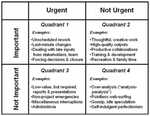
In Young Life we should have a schedule that enables us to abandon annually. Get away for a day or two before the fall starts. Get rid of what’s no longer useful. Set your priorities for the year. Then maintain those priorities monthly, withdraw weekly for rest, and divert daily our energy towards our goals.
When we seek to plan and adjust, let us remember what we can do with and inside time, and what our human limits prohibit.
We CANNOT... but we CAN...
- We cannot MANAGE time - it is a gift. We can manage ourselves and our actions
- We cannot do MORE than one thing at a time. We can sharpen our focus, remove distractions. Since everything is accessible and instant, we must have occasions where we turn it off. Avoid whims and wasting time: games, social networking, email checking when working.
- We cannot MEET EVERY NEED. We can act on purpose - be purpose driven instead of individual needs driven
- We cannot WORK WITHOUT REST. We must Sabbath - stop producing and consuming and acknowledge God will provide. We can rest and renew ourselves
- We cannot OVERVALUE WHAT WE DO. We can realize the importance of who we are and realize God is interested in us BEING fully who we are created to be.
We’d like to suggest two tools for finding a healthy productive rhythm for the next year of staff. The first is an ideal week. The second is a weekly review.
Build an, “ideal week,” for your whole life. Color code it for personal activities and Young Life work. Work on it in 30 min increments for attention to detail. The goal is to make time for all of the important work as well as the commitments you’ve made to yourself, others and the job each week. The word, “ideal,” is used because we know there are weeks with travel, emergencies, or sickness that will derail even the best plans.
Think through, and start to create, your ideal schedule. Your trainer will send you a blank document you can use to get started.
Make sure your ideal week includes:
- Personal health and spiritual practices
- Family/friend priorities
- Sabbath
- Direct Ministry (Contact Work, Team Meetings, Club, Campaigners….)
- Resource Development
- Leadership Development
- Community Development
- Administration and Communication Work
- Time for training, reading or study work - like Leadership 1 and 2, New Staff Training or other classes.
- Non-urgent but important work (planning for the future, camps….)
When you look at the details of the schedule, don’t fear the structure.
- Be firm but flexible
- Adjust out of productivity not laziness
- Manage the structure, don’t let the structure manage you - people over tasks when necessary
- Don’t fear Structure - there is real freedom in life-giving limits
- Structure serves goals, dreams, health, longevity, and freedom!
Remember you are called to be faithful to the God who set time in rhythmic succession. He invites people to join in redemptive, reconciling, and renewing work by the power of the Spirit and in the manner of the Son. Time is a gift that he has given you. Learn to use it to honor him.
ACCOUNTABILITY:
- Do you HAVE a semester or school year plan for your ministry?
- Is it ACTIVE with all the dates for Clubs, Discipleship Groups, Leader Meetings, Prayer Gatherings, Country Conferences, and so on?
- Is your plan SHARED with all of the leaders and regularly discussed so they are aware of all upcoming activities and events?
- Are leaders GROWING in how their participation and ownership of ministry activities as they understand the ministry plan?
ACTION STEPS:
- Think about this past school year. Can you identify the busy seasons or perhaps others where you had some down time? How did you balance and maintain priorities between what was urgent/non-urgent but still necessary? How did you keep up with what was important, urgent and always present? Were there times you felt directionless, overwhelmed or stuck? When were the times you felt healthy, deliberate, and productive? Write your answers out and bring them to your next training meeting.
- Prepare an ideal weekly schedule for yourself using the guidelines above. Bring this schedule to your next training and supervision meetings to discuss. Make adjustments as necessary and print it/enter it into your online calendar to help guide your time during your “normal” weeks.
- For three weeks on Fridays spend 30 minutes and review your week with the Weekly Schedule Review Guide (link here). After you have completed this for the week send it to your supervisor and your trainer.
