
Leadership 2: Missional Community
Part 1
INTRODUCTION
Our vision in Young Life says:
Together, we are compelled to model the way of Jesus in the lives of young people, to develop as leaders, to inspire volunteers and to go as a diverse community on mission — resulting in more adolescents known by name, and in more kids knowing Jesus and discovering their Kingdom purpose.
We accomplish this vision, and the mission of Young Life, together. We do this in community with other believers who share the mission of introducing young people to Jesus Christ and helping them grow in their faith. As staff people, a key piece of our role is to build and equip missional communities. We are not looking to just build teams that come together to organize an event or meet off and on to plan. At their core, our teams are communities of people connected in relationship – relationship with our Lord, relationship with each other – who are working together in mission to reach young people in our geography.
Evidence of staff demonstrating this objective looks like:
- Regular missional community meetings, ideally multiple times a month
- A focus on relationships, spiritual growth, mission and planning in our meetings
- Ministry team meetings include prayer and time in scripture (discipleship)
- They are building a team that has the knowledge, skills and motivation to succeed
- Can assess the needs of the team and the individuals. Knowledge, skill or motivation.
- Can have coaching conversations with their volunteers to grow as a leader.
LOOKING INTO SCRIPTURE
Our Triune God by definition invites us into deep interdependence and co-working with others. Spend some time in the scriptures listed below. Then write a few sentences of personal reflection for how these scriptures speak to our work with others. Bring these sentences to your training meeting.
- John 17:13-26 Jesus prayed for unity by the Spirit for the followers of Jesus for the declaration of God’s revelation in the world.
- Romans 12:1-6 The idea that God intends for His people to operate as a connected body, counter-culturally, and in sacrificial and shared service to the world.
- Philippians 2:1-4 What encouragement, fellowship, and comfort we have together in Christ! How do we live connected to each other and on mission with Christ through the Spirit?
REFLECTION QUESTION FROM SCRIPTURE STUDY
- What themes or insights did you glean about building and leading missional communities from the study of these texts? Look especially for the call to unity inside the diverse body of Christ.
Now let’s consider the missional communities (teams) in your area.
In Young Life you will lead some teams and also serve on teams that others lead. Which are which? For example, as staff you might be the team leader of a Wyldlife, Capernaum, YoungLives, YL University, or Young Life team in your area. You also might be a member of the local staff team that the Area Director leads or a member of the country team.
For this post, please focus on a missional community team that you are leading.
One question we need to be able to answer as a missional community is: What is our purpose?
If we are a missional community – what is the mission that we are on? Many areas find it helpful to have a “mission statement” for their ministry team. How do you think each of your leaders would answer the question, “What is our purpose as a team?” Maybe it’s time to do some research and as them that in your next individual meetings with them. Here are some more questions to consider:
DEFINING GOALS AND PURPOSE
People want to be part of something that has direction and purpose. They also want to be part of something that brings them life and where they see they have something to offer. Do you and your team talk about the Young Life mission statement regularly – does this give you purpose for what you do each week with young people? How have you and your team adapted the bigger Young Life mission to your geography? How does being part of this missional community challenge every person to grow deeper with Jesus?
- What is your team mission statement?
- How often do you talk as a team about your mission and purpose?
- Have your leaders grown spiritually this year as they are part of your missional community?
- How do you challenge each other to be Holy-Spirit led leaders? How do you model this?
The purpose of our team and ministry might seem obvious to us, but it takes a lot of focus and regular discussion to make sure that our true purpose stays the center of all we do. Once we’ve defined who we are as a team, and this is critical to revisit and remind ourselves of each year, we need to take some time to think about how effective we are as a team. Patrick Lencioni has researched what makes all types of teams – business, organizational and mission teams – dysfunctional. Spend some time reading through these points and think about your team that you lead. Please search online for a description of Lencioni’s 5 Dysfunctions in your language or watch a video of him presenting on these 5 Dysfunctions.
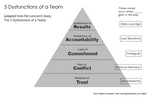
Effective organizations are built out of effective teams. Effective teams are ones who have found the ability to achieve meaningful group results. To achieve those meaningful results, the team has to overcome the common 5 dysfunctions:
1. Absence of Trust
Teams must have the ability for people to be vulnerable. Members need the ability to point out flaws and weaknesses and know their strengths. It is the groundwork for any high functioning team.
2. Fear of Conflict
If teams don’t have trust, then they can’t disagree. Can someone speak what they feel and know they are heard. When there is trust, conflict is intelligent people offering all possible ideas.
3. lack of commitment
Goes beyond consensus. Consensus is about all agreeing. Commitment goes beyond that. Can a team sit focused on the same goal without being in complete agreement? Consensus is right now, Commitment is what “will be.” It is helpful to ask at the end of a meeting, “What did we agree to do together today?”
- Commitment is the hard work. Consensus makes it feel like we are all done. Consensus is the false summit. Commitment is the “buy in” piece.
- Unity will be a rejection of Uniformity
4. Accountability
The willingness of team members to remind one another when they are not living up to the performance standards of the group. And likewise, the ability of team members to receive and respond to these reminders in a way that realigns the team’s actions and purpose.
5. Results
It is important to have clearly defined outcomes and collective results. Do we know what we are aiming for? How do we know if we get there? If our results aren’t clear, we will tend to measure things that don’t help us achieve our most meaningful goals.
QUESTIONS TO ASK YOURSELF AND YOUR TEAM
- What is evidence of trust among our team?
- Can you think of a recent conflict that was resolved well among our team? One that needs to be resolved?
- What is one of the most enduring commitments you have made?
- Do we provide space among our team for accountability?
- Are we clear on the results that matter for our team? Are they agreed upon?
ACCOUNTABILITY
- Do you have a mission or purpose statement for your team? Do you have specific goals that you and your team are working towards this year? HAVE
- Do you regularly talk about your purpose (the mission part of our community!) as a team at each of your meetings? SHARED
- Is your team actively living out its mission, and each member growing spiritually? ACTIVE
- Is your team attractive to others because of the deep relationships and community of your team and the mission that you are on together? GROWING
