
Leadership 2: COMMUNITY ENGAGMENT PART 3
Coach and develop a team of leaders in the context of relationships and with Emotional and Cultural Intelligence. (EQ/CQ)
INTRODUCTION
Young Life needs staff who understand themselves, others and can communicate, lead and love effectively. Emotion Intelligence (EQ) and Cultural Intelligence (CQ) are ways to describe and measure our abilities in this area. Not only are we more effective when we have these important skills, but we better reflect God’s kingdom and His values in our ministry.
This lesson is divided into Emotional Intelligence and Cultural Intelligence sections.
Emotional Intelligence (EQ)
Evidence of staff demonstrating this objective looks like:
- Demonstrates self awareness emotionally and seeks to increase awareness and self control.
- Demonstrates growth in thoughtful response versus reaction.
- Their self awareness leads to continual transformation.
Emotional Intelligence “EQ is knowing what is going on inside of you and having awareness of how that is coming out in real time.” John Evans
Emotional Intelligence, as a psychological theory, was developed by Peter Salovey and John Mayer. "Emotional intelligence is the ability to perceive emotions, to access and generate emotions so as to assist thought, to understand emotions and emotional knowledge, and to reflectively regulate emotions so as to promote emotional and intellectual growth."- Mayer & Salovey, 1997
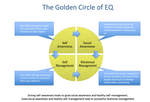
The following steps describe the five components of emotional intelligence at work, as developed by Daniel Goleman.
The Five Components of Emotional Intelligence are:
- Self-awareness: The ability to recognize and understand your own emotions and their effects on others. It includes self-confidence, realistic self-assessment, and a sense of humor.
- Self-regulation: The ability to control or redirect disruptive impulses and moods, with trustworthiness, integrity, and openness to change.
- Internal motivation: A passion for internal reasons like personal vision, curiosity, and joy in work, leading to persistence and optimism.
- Empathy: The ability to understand and respond to the emotions of others, with skills in talent management, cross-cultural sensitivity, and client service.
- Social skills: Proficiency in managing relationships, building networks, and leading teams, with effectiveness in leading change and building rapport.
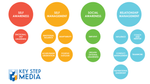
Here are some diagrams to help explain further
The Johari Window
The Johari Window is a conceptual model used to improve self-awareness and interpersonal relationships by understanding how individuals are perceived by themselves and by others, and by exploring the exchange of information through feedback and self-disclosure. This model uses a four-quadrant diagram to categorize aspects of self-knowledge based on whether they are known to the self and/or to others.trates self awareness emotionally and seeks to increase awareness and self control.
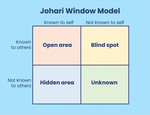
Watch this video on the Johari Window Model
ACTION STEPS
- READ: The above information about EQ
- REVIEW: The above information, the 4 Domains, the 12 Competencies and the Johari window
- REFLECT: Does this make sense? What questions do you have? What does this look like in your own life? Which competencies and capabilities are you stronger and more comfortable with? Which competencies are you weaker and less comfortable with? How can you develop these areas and capabilities? Who do you have in your life that serves in this role and how have they helped you? Do you need help to find someone who can help you increase your self understanding?
- PLAN: make 1 or 2 goals to increase your EQ
- DISCUSS: Talk through the Johari window together with your supervisor. Review reflections and plans and goals for growth.
Cultural Intelligence (CQ)
Evidence of staff demonstrating this objective looks like:
- Understanding CQ and are aware of what areas need development in their life
- Leading with the desire for CQ.
- Can assess the ministry with CQ and Understand what might lead to better CQ behavior.
WHY DO WE NEED CQ?
Europe is a continent with significant cultural diversity. In 2024, 9.9% of the EU population (44.7 million people) were born outside the EU, according to the European Commission. Additionally, 4.0% were born in another EU country, and 6.4% are non-EU citizens. These statistics underscore Europe's evolving demographic landscape, where multiculturalism is becoming a defining feature of many nations.
WHAT IS CQ? What’s your CQ?
CQ gives us some tools to understand our own background and lovingly relate across cultures.
Young Life has worked in partnership with the Center for Cultural Intelligence for many years. This centre developed the idea of CQ. Cultural intelligence (CQ) goes beyond just cultural competence—it’s a comprehensive strategic approach for leaders to thrive in multicultural, globalized environments. CQ is the differentiator that determines a leader's ability to effectiveness in multicultural settings.
The four pillars of CQ—Drive, Knowledge, Strategy, and Action—are grounded in academic research across 25 countries, showing a strong correlation between a leader's CQ and their ability to achieve performance objectives.
- CQ Drive involves intrinsic motivation and confidence to engage with cultural challenges, which is essential to overcoming the apathy that often accompanies cross-cultural work.
- CQ Knowledge refers to the understanding of cultural differences, helping leaders recognize how culture influences communication, decision-making, and behavior. This knowledge is the foundation for effective cross-cultural interactions.
- CQ Strategy focuses on making sense of cultural diversity by slowing down to observe and plan. This involves reflecting on one’s own biases and expectations, adjusting strategies, and ensuring alignment with cultural realities.
- CQ Action pertains to the leader’s ability to adapt behaviors—both verbal and nonverbal—to suit the cultural context, ensuring effective communication and leadership without compromising authenticity.
These four dimensions work together in a continuous cycle, enabling leaders to engage in cross-cultural interactions with increasing competence and confidence. Leaders don’t need to be experts in every culture, but applying the CQ framework allows them to effectively collaborate and lead in diverse global contexts.
Read ideas how to help your CQ
CQ ACTION STEPS
REFLECT: Pray and ask the Lord to help you see and understand yourself and your community better. The consider some of these questions:
- How would you describe the culture(s) and the people you are working with?
- What do you need to know more about? What would help with that learning?
- Which of the 4 CQ capabilities are you stronger and more comfortable with? Which are weaker and less comfortable with?
- What has God impressed upon your heart from learning about CQ? What has affirmed you or challenged you?
- What kids in your area feel “furthest out”? What do you need to learn to reach them
- What step can you take to build and sustain multicultural teams and ministry?
- What questions do you have about why this is an important conversation as you train to fulfill your calling?
PLAN: After your reflection, read the linked document with some ideas for improving CQ in each of the 4 areas. Set 1 or 2 measurable goals for CQ growth.
DISCUSS: Share these goals with your supervisor, ask for their input and set a timeline to complete them
ACCOUNTABILITY
- HAVE - Do you have roots on your Leadership Tree who can challenge you in your self-awareness about your own Emotional Intelligence or Cultural Intelligence?
- ACTIVE - Do you actively seek out conversations with others that will allow you to grow in your emotional and cultural intelligence?
- SHARED - Do you share what you are learning about yourself, your EQ and CQ with others on your team? Do you share the value you see in growing in your self awareness?
- GROWING - Do you see your self awareness growing and your own EQ and CQ deepening? As this happens, do you see greater trust and deeper relationships growing on your team?
